

Back to Evil Eye
The evil eye can mean either a harmful gaze or the eye-shaped charm used in response to it. In many traditions, envy or intense admiration is thought to bring misfortune. The familiar blue-and-white Nazar bead belongs to the other side of the story: it is worn or displayed as an amulet, a cultural symbol, or simply a meaningful design.
The feared gaze and the eye-shaped amulet are two sides of the same story, not the same thing.
What Does the Evil Eye Mean?
The phrase evil eye sounds contradictory because everyday English uses it for two connected ideas. The first is the feared gaze: a look associated with envy, resentment, or unusually intense admiration. The second is the eye-shaped object worn or displayed in response. One is the danger in the story; the other is the amulet.
That distinction clears up a common source of confusion. When an article calls the evil eye a curse, it is usually describing the gaze or the wider belief. When a shop, museum, or family member calls it a protective symbol, they are usually talking about the bead or amulet. Both statements make sense once you ask which side of the tradition is being discussed.
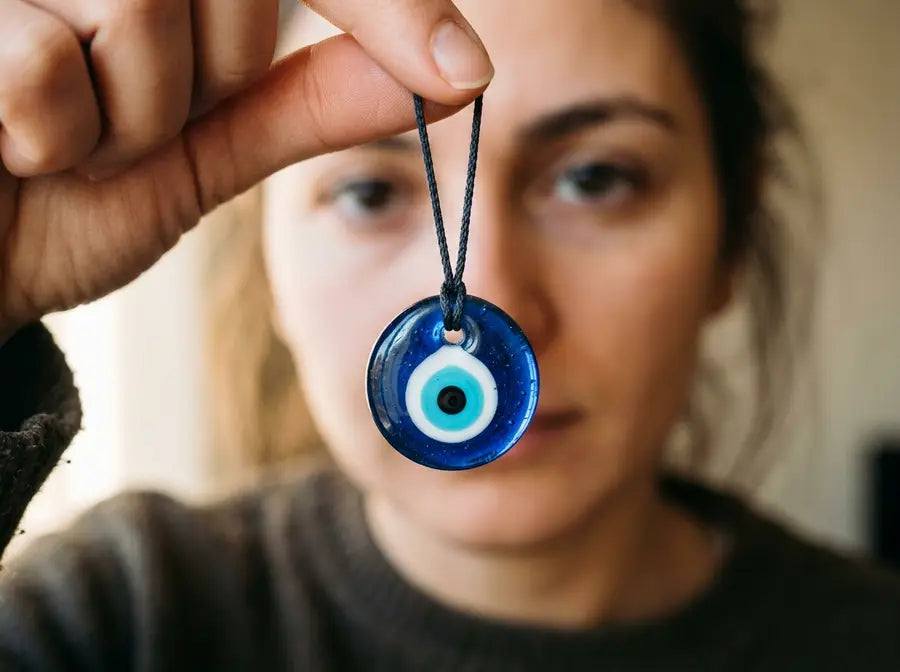
A blue eye necklace is therefore not normally a celebration of something evil. One wearer chooses it to recall a family custom; another sees a wish for protection, a new beginning, or simply a design that suits them. The object has no single meaning for everyone, but its recognizable form comes from a much older concern about the attention and envy directed at a person.
To understand why an eye became the answer, it helps to begin with the moment these traditions often focus on: when something good becomes visible to other people.
Why Envy Sits at the Center of the Story
Imagine a family introducing a new baby, opening the door to a new home, or celebrating a wedding. Praise is welcome, yet being admired also feels exposing. The same tension appears around beauty, health, a promotion, a successful harvest, or any good fortune visible to other people. Evil-eye traditions give that uneasy feeling a familiar shape: the gaze of someone who wants, resents, or dwells too intensely on what another person has.
Not every tradition describes that gaze in the same way. Some accounts treat it as deliberately hostile. Others allow admiration to cause harm without the admirer intending it. This difference explains why customs extend beyond guarding against an obvious enemy. A blessing after a compliment, a modest response to praise, or a gift given at a life transition all acknowledge the vulnerability of being noticed.

These are cultural beliefs rather than a measurable account of physical cause and effect. Smithsonian's cross-cultural collection on the evil eye is useful precisely because it presents the subject across societies rather than as one doctrine with a single rulebook. The repeated theme is envy; the language, gestures, objects, and explanations change from place to place.
Our guide to where the evil eye originated follows that longer history. What matters here is what comes next: once a community gives the feared gaze a name, people look for words, actions, and objects that answer it. The Nazar bead is one of the most recognizable answers.
From the Feared Gaze to the Nazar Boncuğu
Nazar refers to the gaze or evil-eye idea in several languages and cultural settings. In Turkish, nazar boncuğu is the name commonly used for the glass eye bead. Without Turkish characters, the spelling appears as nazar boncugu; in English, people often shorten it to Nazar bead or Turkish evil eye.
The classic bead is round or slightly flattened. Concentric areas of dark blue, white, pale blue, and black create the impression of an open eye. Blue is the color most closely associated with this design, although contemporary versions use many palettes and materials. The simple geometry is part of what makes the motif easy to recognize across a doorway, on a wall, or at the center of a small piece of jewelry.
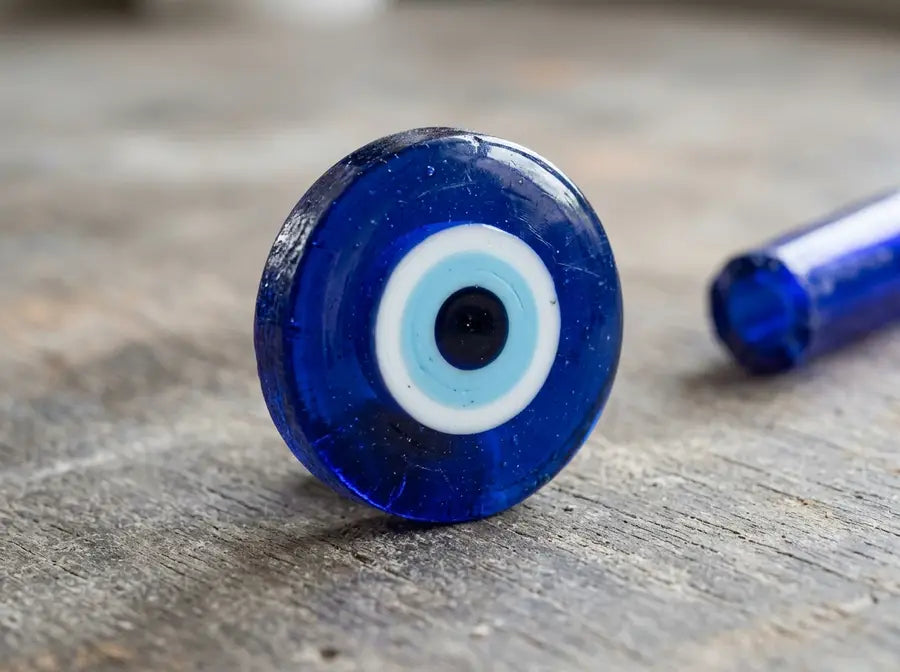
UNESCO's documentation places Nazar Boncuğu within a Turkish glass-making tradition. Artisans heat and shape glass, then build the eye from separate layers of color. That craft context matters: a handmade glass bead belongs to a material tradition as well as a symbolic one. It carries a different history from an eye merely printed on a modern accessory, even when the two designs look related.
People wear finished beads, place them near an entrance, carry them in a vehicle, or give them for a birth, marriage, or new home. These uses turn an abstract concern about envy into an object that accompanies everyday life. They remain customs and expressions of meaning, not guarantees that an amulet will change health, luck, energy, or future events.
Once the eye appears on jewelry and decor, however, it begins to resemble other eye-bearing symbols. That is where a second kind of confusion starts.
Evil Eye, Hamsa, and Eye of Horus Are Different Symbols
A round Nazar bead, a hand with an eye in its palm, and the long stylized eye seen in ancient Egyptian imagery are often grouped together online. Their shared eye motif creates the resemblance, and modern jewelry sometimes combines them, but their basic forms and histories are different.
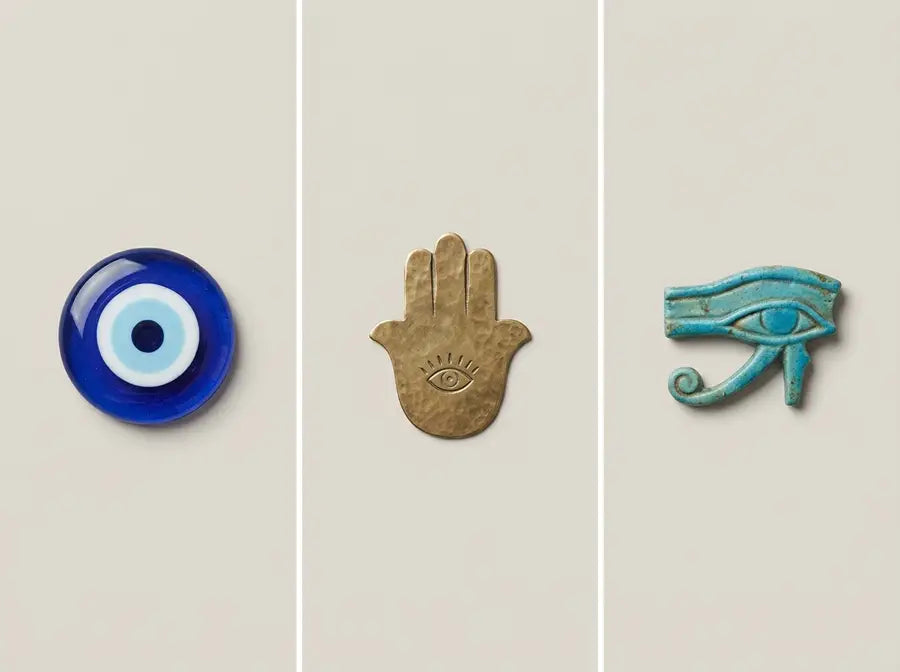
- Evil eye or Nazar motif: usually a round eye or concentric circles associated with the feared gaze and the amulet used in response.
- Hamsa: a hand-shaped amulet found in Middle Eastern and North African contexts. Some versions place an eye in the palm, while many Hamsa designs have no eye at all.
- Eye of Horus: also called the wedjat eye, an ancient Egyptian symbol with a distinctive brow and markings drawn from human and falcon-eye forms.

The easiest way to tell them apart is to look at the complete outline before focusing on the eye. Concentric circles usually point toward a Nazar-style motif. A symmetrical hand points toward a Hamsa. An extended eye with a curved marking below belongs to the wedjat form. Some pendants borrow from more than one, so the most accurate name acknowledges the combination rather than forcing it into one category.
The distinction is not just academic. It helps a reader understand what they are wearing, choose a gift with care, and avoid treating several cultural objects as interchangeable decoration. The Hamsa vs. evil eye comparison looks at those two motifs side by side, while the guide to Hamsa hand meaning explains the hand symbol in its own context.
Knowing the name of a symbol is a useful start. Its meaning often shifts across families, regions, and religions, which is the next part of the story.
How Evil Eye Customs Change Across Cultures
There is no single evil-eye ceremony shared around the world. In one home, a blessing follows admiration for a child. Elsewhere, a bead hangs beside the door, a thread is tied around the wrist, a prayer is spoken, or a hand gesture is used. The concern about envy feels familiar across communities even when the response looks completely different.
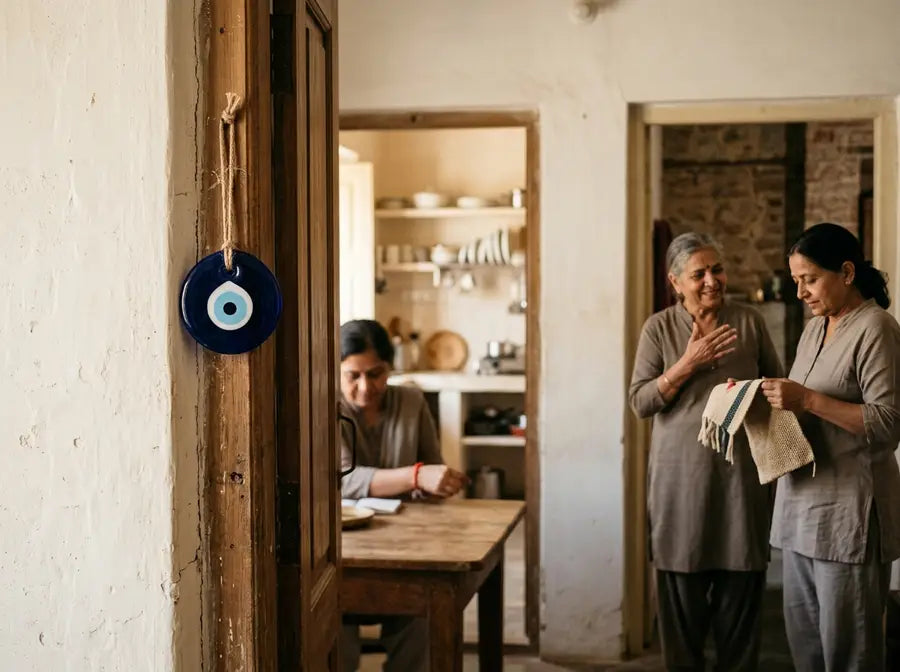
Names change as well. Nazar is common in Turkish and nearby linguistic contexts, while mal de ojo is familiar across many Spanish-speaking communities. Evil-eye traditions have also existed alongside Jewish, Muslim, Christian, Hindu, and local folk practices. This broad history does not make the belief the property of one religion, nor does it mean every person within a culture accepts or observes it.
It is better to think of a shared question with many local answers: what happens when envy is directed at someone, and how should a family or community respond? That frame leaves room for real differences instead of flattening every prayer, thread, bead, and gesture into the same ritual.
For more examples from particular regions, read our guide to evil eye meanings across cultures. On this page, the cultural variation matters because two people can recognize the same blue eye yet describe its personal meaning differently.
What the Evil Eye Means in Modern Jewelry and Home Decor
Today, the eye motif moves easily between tradition, identity, gifting, and design. One person wears a bracelet received from a relative. A friend chooses a necklace to mark a move, a new job, or another beginning. Someone else is simply drawn to the geometry and deep blue glass. These reasons coexist; an object carries inherited meaning while still belonging to an everyday style.

Context often tells you more than the motif alone. Worn close to the body, it feels personal or connected to a relationship. Placed by an entrance, it reflects a household custom. Given as a gift, it communicates care without requiring the recipient to share every belief associated with it. Asking who chose the object, why, and where it is used is more revealing than assuming one fixed definition.
Color needs the same care. Blue remains the most recognizable Nazar color, but the many color charts found online are not one ancient system followed everywhere. Other shades often reflect a maker's palette, a retailer's interpretation, or a wearer's preference. Our guide to evil eye color meanings separates common contemporary associations from universal-sounding claims.
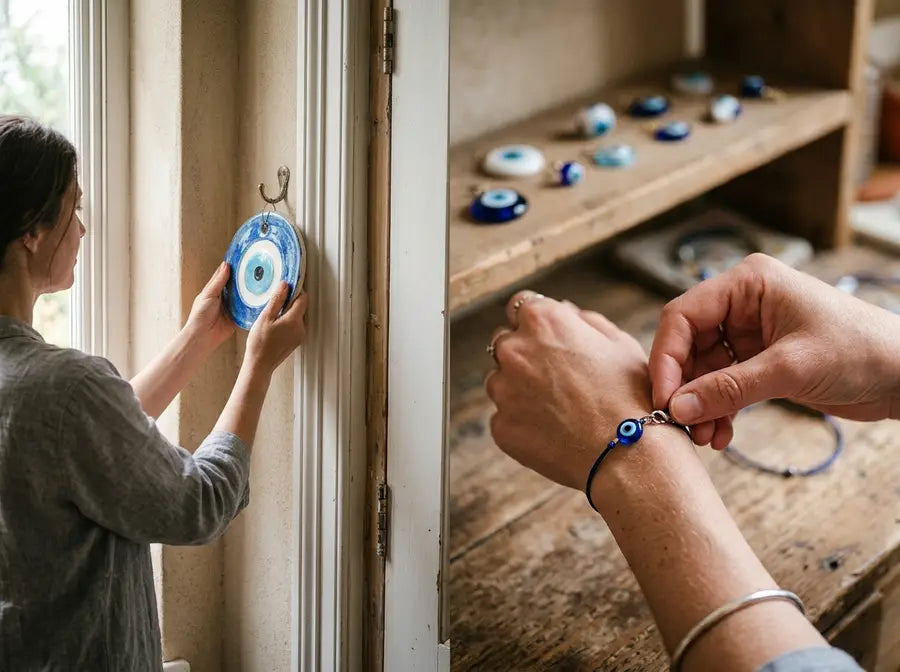
If you are choosing a piece, practical details are worth considering before symbolic promises: size, construction, comfort, weight, and where the object will be worn or displayed. The evil eye buying FAQ offers a fuller checklist. The examples below show the same motif moving between something worn, something useful, and something displayed at home.
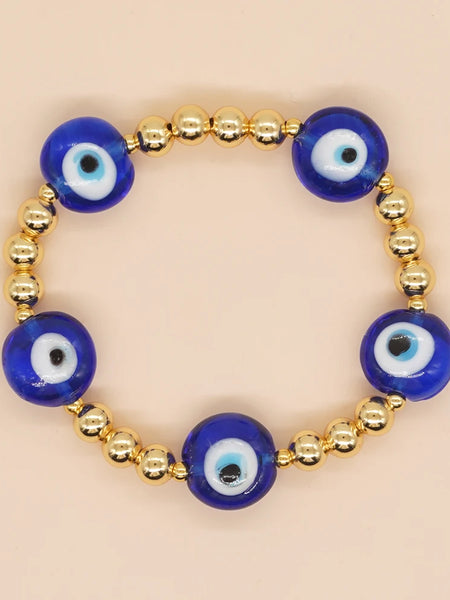
Evil Eye Beaded Bracelet with Blue Discs and Gold Tone Spacers
$11.24
View
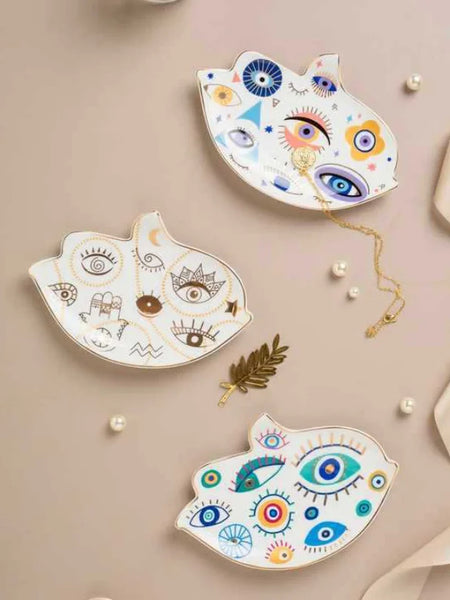
Evil Eye Jewelry Tray with Pointed Rim in Three Designs
$33.10
View
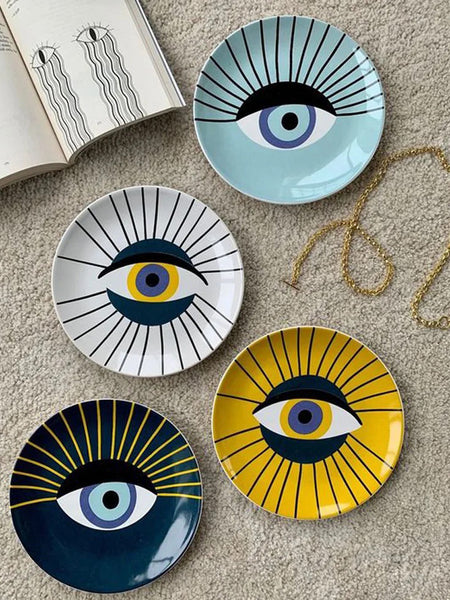
Evil Eye Ceramic Plates with Sunburst Designs
$20.14 - $38.98
View
Another useful way to browse is by the role the object will play rather than by a promised outcome: personal jewelry on one path, home decor on the other.

180
Products
Evil Eye Jewelry
Shop Evil Eye jewelry in symbolic necklaces, bracelets, rings, earrings, pendants and charm styles for everyday layer...
Explore
55
Products
Evil Eye Home Decor
Shop Evil Eye home decor, from wall hangings and decorative accents to stylish pieces for shelves, tables, and everyd...
ExploreFrequently Asked Questions
Is the evil eye good or bad?
The feared gaze is the harmful part of the tradition. The eye-shaped amulet is the response and is usually understood positively by people who wear or display it. Everyday English calls both of them the evil eye, which creates the apparent contradiction.
What does the evil eye symbol represent?
It commonly represents awareness of the evil-eye belief and a wish for protection from envy or harmful attention. Depending on the wearer and setting, it also represents cultural heritage, family custom, a relationship, a new beginning, or personal style.
Is Nazar the same as the evil eye?
The terms overlap, but they are not exact synonyms in every sentence. Evil eye names the gaze, the broader belief, or the amulet in everyday English. Nazar relates to the gaze or evil-eye concept, while nazar boncuğu more specifically names the Turkish glass eye bead.
Do different evil eye colors have different meanings?
Blue has the clearest connection to the familiar Nazar bead. Other colors often receive meanings in contemporary jewelry and gift guides, but those charts are not necessarily ancient or universal. Treat a color meaning as a modern association unless it is tied to a specific, documented tradition.
Can anyone wear an evil eye symbol?
People from many backgrounds wear the motif today. A respectful approach is straightforward: learn what the object means in the tradition you are referencing, do not use it to claim an identity that is not yours, and do not promise that an amulet will change someone's health, luck, or future.
How are evil eye amulets traditionally used?
Practices vary. People wear or carry beads, hang them in a home or vehicle, or give them during a life transition. Our guide to traditional evil-eye protection practices explores those customs in more detail. They are cultural practices, not guaranteed effects.
What to Remember
The evil eye begins with a traditional concern about an envious or intensely admiring gaze. The familiar eye-shaped amulet is one response to that concern, not the harmful gaze itself. From there, meaning becomes more personal: a Nazar bead connects someone with a craft tradition, a family, a gift, a home, or simply a design they enjoy.
Understanding that journey—from gaze to amulet, and from shared tradition to personal use—makes the symbol easier to read without reducing it to either superstition or decoration. It also leaves room for the Hamsa, the Eye of Horus, and local evil-eye customs to keep their own histories.
