

Back to Evil Eye
A grey evil eye is commonly associated today with neutrality, stability, balance and composure. Those grey-specific meanings are modern interpretations, while the eye motif carries the older cultural association with protection from the evil eye.
The useful distinction is simple: the eye and the color do not carry the same kind of history. Grey can express a quiet personal intention or suit an understated style, but it does not have one universal ancient meaning or a guaranteed effect.
Grey adds a modern language of balance and composure to an eye symbol with a much older protective history.
What does the grey evil eye mean?
The short answer is that a grey—or gray—evil eye is usually read as a modern symbol of neutrality, steadiness and emotional balance. Some people choose it as a reminder to pause before reacting, maintain clear boundaries or stay composed when a situation feels uncertain.
The protective meaning belongs to the broader evil-eye amulet tradition, not to grey alone. The shade adds a personal or design-led layer to that older symbol. It is more accurate to say that grey suggests balance than to claim that a grey charm creates balance or controls what happens to its wearer.
If you want to compare the wider palette, the guide to evil eye color meanings separates established tradition from newer associations for each shade.

Is the grey evil eye meaning traditional?
Belief in the evil eye is old and widespread, although its language, rituals and protective objects differ across communities. The familiar eye-shaped amulet is one response to that belief. In Turkish and Anatolian contexts, the glass eye bead is commonly known as a nazar boncuğu.
Blue has the clearest documented color identity in the nazar tradition. Research on Turkish folk culture notes that the much wider range of colored eye beads belongs largely to contemporary popular culture, while blue remains central to the traditional form. That makes a fixed ancient meaning for every modern shade unlikely.
The eye symbol and the color do different work
The eye motif connects a grey charm to the broader belief about watching, envy and protection. Grey changes the visual tone and the intention a modern wearer may attach to it. Keeping those layers separate respects the symbol's history without turning a recent color choice into an invented ancient rule.
Why the distinction matters
Color charts often present every shade as if it has one permanent spiritual function. Reliable cultural sources do not establish a universal grey code. For the wider historical context, read where the evil eye belief originated and how its meanings changed across places and periods.

What grey can symbolize today
Modern grey evil eye meanings are most useful when treated as interpretations rather than facts. A person can select the shade for a quality they want to remember, a message they want to give, or a palette that fits their daily life.
Neutrality without passivity
Because grey sits visually between black and white, it can suggest a middle position: listening before deciding, leaving room for nuance or stepping away from an all-or-nothing response. This is a contemporary metaphor, not evidence that the color changes a person's mood.
Stability and measured boundaries
Grey can also represent consistency and restraint. Someone might wear it as a private cue to hold a boundary without escalating a conflict, or choose it for a gift that acknowledges a period of change without promising that the charm will solve it.
An understated visual choice
Not every choice needs a spiritual explanation. Charcoal, smoke and pale grey tones work easily with neutral clothing, silver-toned accents and quiet interiors. Choosing a grey evil eye for its appearance is reasonable when the older cultural background of the eye motif is still treated with care.

Grey vs. black, white, silver and blue evil eyes
Grey overlaps with several neighboring shades, so the most useful comparison is about emphasis rather than power. These descriptions reflect common contemporary interpretations unless noted otherwise.
- Grey emphasizes neutrality, composure and a steady middle ground.
- Black is often chosen to represent firm boundaries, resolve and a stronger visual contrast.
- White is commonly linked with clarity, simplicity and a fresh perspective.
- Silver suggests reflection and quiet dignity, but a silver appearance does not prove that an object is made from silver.
- Blue has the clearest traditional connection with the familiar nazar bead and its protective role in Turkish folk belief.
None of these colors forms a measurable ranking of protection. The comparison helps you describe the message or mood you prefer; it does not identify a strongest charm or predict an outcome.
How to wear or display a grey evil eye
The most appropriate use depends on whether the object belongs to a family or cultural practice, carries a personal intention, marks a gift, or simply fits a visual setting. There is no universal rule that a grey charm must be worn or placed in one location.
Grey evil eye jewelry
A bracelet keeps the symbol visible during ordinary routines, while a necklace, ring or pair of earrings makes it part of a wider outfit. If comfort and frequency matter more than color alone, use the guide to choosing an evil eye bracelet for daily wear to compare fit and practical use.

These three bracelets show different ways to wear the eye motif, from a wide beaded design to a slimmer braided style. Product cards may show each item's default color, so open the item and compare its visible option images before choosing a grey version.


Evil Eye Beaded Bracelet with Scroll Spacers and Black Cord
$10.75 - $10.99
View


Triple Blue Evil Eye Beaded Bracelet with Paired Chevron Spacers
$10.28 - $10.88
View
Grey evil eye home decor
In a home, a grey eye can work as a quiet accent near an entrance, on a shelf or within a neutral wall arrangement. Some households place eye amulets where arrivals and attention enter the space; others treat them as decor with cultural meaning.
The guide to using evil eye decor at home covers practical placement without turning belief into a guarantee.
These home pieces show how the motif can move from a narrow wall hanging to a larger textile or floor accent. Check the visible option image on the product page instead of assuming that every design shown on a card is grey.


Evil Eye Macrame Wall Hanging with Seven Blue Eyes and Long Fringe
$18.53
View


Evil Eye Wall Hanging with Eye-Shaped Frame and Beaded Fringe
$17.94
View


Evil Eye Macrame Wall Hanging with Blue Pendant and Two Fringe Styles
$17.18 - $17.68
View
Giving one as a gift
A grey evil eye can suit a recipient who prefers subtle colors or values balance and restraint as personal ideas. Explain that the protective eye belongs to an older tradition while the grey message is a modern interpretation you selected for them. That is more thoughtful than promising luck, safety or emotional change.


178
Products
Evil Eye Jewelry
Shop Evil Eye jewelry in symbolic necklaces, bracelets, rings, earrings, pendants and charm styles for everyday layer...
Explore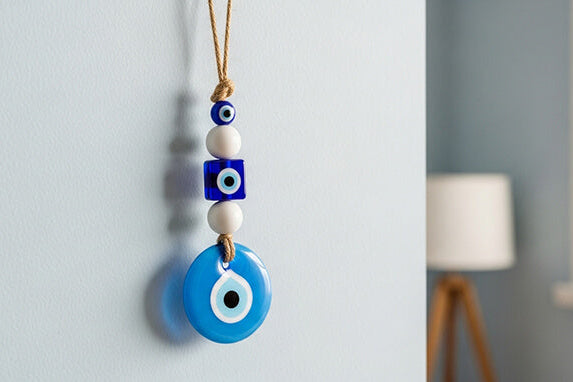
55
Products
Evil Eye Home Decor
Shop Evil Eye home decor, from wall hangings and decorative accents to stylish pieces for shelves, tables, and everyd...
ExploreHow to choose a grey evil eye piece
Start with the meaning you can explain honestly, then check the object itself. A useful choice should make sense in its setting and should not depend on an unsupported promise.
- Decide what matters most. Choose between cultural continuity, a personal reminder, a gift message and visual preference.
- Check the visible shade. Grey may appear charcoal, smoke, blue-grey or almost silver. Product photos and variant names should agree before you rely on a color label.
- Keep color and material separate. A grey or metallic-looking charm does not reveal whether it is glass, stone, enamel or a particular metal.
- Choose the format for real use. Consider wearability, placement, size and care rather than selecting an object only because a color chart assigns it a dramatic benefit.
If you are still deciding between a symbolic piece and a practical format, the evil eye buying FAQ provides a broader first-piece checklist.
Grey evil eye questions
Does a grey evil eye protect you?
Within evil-eye traditions, people may wear or display an eye amulet as a protective symbol. That is a cultural or personal belief, not a result that can be tested or guaranteed. Grey does not have a verified extra level of protection over another color.
Is grey the same as silver?
No. Grey describes a neutral color, while silver can describe a color, a finish or a material. A photo may show a silver-toned setting around a grey eye, but material details must come from verified product information rather than appearance.
Can grey be mixed with other evil eye colors?
Yes. There is no universal rule that limits a person to one shade. Grey can soften a brighter palette, sit beside black or white, or provide a neutral background for blue. Any combined meaning remains personal unless it is tied to a specific, documented practice.
Do grey and gray mean the same thing?
Yes. Grey is more common in British and international English, while gray is more common in American English. The spelling does not change the symbol or its interpretation.
Is the grey evil eye an ancient Egyptian symbol?
There is no reliable basis for giving the modern grey nazar an ancient Egyptian origin. Ancient Egypt had its own eye symbol, the wedjat or Eye of Horus, with a distinct myth and meaning. Similar eye shapes should not be treated as proof that the symbols share one history.
Choose grey with context
A grey evil eye can carry a clear modern message: neutrality, steadiness, measured boundaries or an understated personal style. Its broader eye motif connects it to older beliefs about the evil eye, but the grey interpretation should remain flexible rather than being presented as ancient or universal.
Choose the shade because its meaning and appearance make sense to you or the person receiving it. Let the charm represent an intention if that is meaningful, while keeping practical decisions—and claims about safety, health, luck or emotional wellbeing—grounded in evidence.
