

Back to Style Guides
The short answer on hamsa vs evil eye: one is a hand, the other is an eye. The Hamsa is an open palm found across several cultures, and the evil eye (nazar) is the eye motif believed to turn a bad stare back on itself.
Below is what each one means and how to pick the one that matches your intent or your gift. After that, whether the two can sit together on one wrist.
Two emblems, one wish. The Hamsa and the evil eye both carry the hope of guarding against harm, one shaped as a hand, the other as an eye.
Hamsa vs evil eye at a glance
The difference comes down to shape and role. The Hamsa is an open palm, usually with an eye set in the center. The evil eye is the gaze on its own, most often a blue glass bead made to return a stare.

Put the two side by side and you can read the contrast in a second. The Hamsa is a full open hand. The evil eye is a single eye drawn in concentric rings. With the Hamsa, fingers up or down shifts the tone a little; the eye just looks outward at whoever is standing there.
Material splits them too. Nazar beads are usually blue glass, while Hamsa pieces lean toward metal, enamel, or set stones. The small eye suits everyday charms and pins. The Hamsa, with more surface to work with, tends to anchor a necklace or a wall piece. Both trace back to overlapping Middle Eastern and Mediterranean roots, not one single source.
What the Hamsa (Hand of Fatima) means
The Hamsa is an open right hand, fingers slightly spread, often with an eye resting at the center of the palm. Many cultures read it as a gesture of protection and welcome. You'll also see it called the Hand of Fatima or the Hand of Miriam, depending on the tradition.

For the fuller story on its origins, its symbolism, and what the finger direction signals, read our Hamsa meaning guide. This section sticks to how it compares with the evil eye.
What the evil eye (nazar) means
The evil eye, or nazar, is the idea that an envious or ill-meaning stare can bring bad luck. The blue glass bead answers that gaze. It looks back, a small token of goodwill rather than a promise of safety.

For the deeper background on its colors, its history, and what the concentric rings mean, our Evil Eye meaning guide covers it. Here we're keeping the focus on how it sits next to the Hamsa.
The core differences between hamsa and evil eye
The points above cover most of it, but the easiest way to hold the contrast is form versus function. The Hamsa is a whole hand you read as a gesture. The evil eye is a single watchful motif with one job, looking back at a stare.

That gap matters when you shop. A Hamsa often holds an eye inside the palm, so it can carry both ideas at once. A nazar bead is just the eye, with nothing around it.

In jewelry terms, the Hamsa shows up as a sculpted pendant in metal or set stone, while a blue glass eye works as a small charm or a wall hanging. Because the Hamsa has more surface, it takes engraving and stone settings well. The nazar stays simple by design.
Hand of Fatima / Hand of Miriam vs evil eye
If you searched hand of Fatima vs evil eye, here's the clarification: the Hand of Fatima and the Hand of Miriam aren't separate symbols. Both are names for the same open-palm Hamsa, carried under different traditions. The name you use usually reflects cultural context, not a change in the shape.
So the real comparison stays hand versus eye. The named hand is the full palm gesture; the nazar is the gaze on its own. A Hand of Fatima often sets that eye inside the palm, which lets it hold both ideas in one piece.

Which one should you choose?
There's no wrong pick. It really comes down to the look you want and the meaning that lands for you, whether that's a sculpted hand or a single watchful eye. Think about your own style, and who the piece is for.
Choose the Hamsa if
Go for the Hamsa if you like a hand pendant with more detail, or if the layered symbolism appeals, since the palm can hold an eye at its center. It makes a strong focal necklace and a thoughtful gift.

If that's you, these Hamsa pieces are a good starting point, and our guide to choosing your first Hamsa piece answers the questions beginners usually have. You'll find them in metal and enamel, some with set stones.


Evil Eye Ring in Blue or White with Hamsa Hand Options
$11.13 - $30.88
View
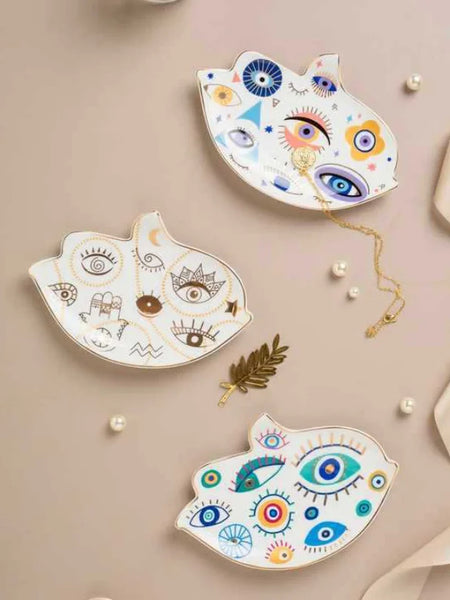

Evil Eye Jewelry Tray with Pointed Rim in Three Designs
$33.10
View


Black Beaded Evil Eye Bracelet with Dotted Hamsa Hand
$10.97
View
Choose the evil eye if
Lean toward the evil eye if you'd rather have a minimal blue motif that slips into everyday wear. The nazar is small and simple. It stacks easily, gives well, and people recognize it without any fuss.

If the eye is your match, these evil eye designs cover bracelets and pendants, plus small charms for daily wear.
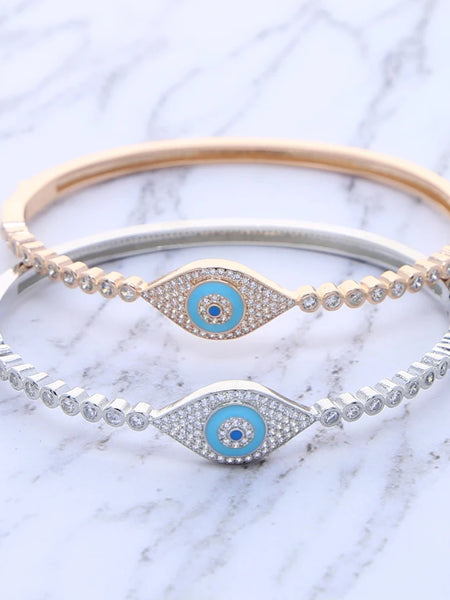

Evil Eye Bangle Bracelet with Blue Center and Round Accents
$19.78
View
 BEST SELLER

Evil Eye Link Bracelet with Ridged Almond Frames
$10.93 - $11.06
View


Evil Eye Chain Bracelet with a Round Centerpiece - Fine or Rectangular Links
$11.19
View
Can you wear hamsa and evil eye together?
Yes, and plenty of people do. Both carry the same protective wish, so pairing a hand with an eye feels coherent rather than crowded. Some wearers like that a Hamsa already has an eye set in the palm.

The trick is balance. Let one symbol lead and the other support, so the pairing reads as intentional, not busy. A focal Hamsa with a small nazar nearby usually works better than two pieces fighting for the same weight.
In practice, pair a larger Hamsa pendant with a smaller nazar bead so one clearly leads. Keep the blue eye as the accent against a neutral or metal Hamsa, and leave a little room between the pieces when you layer them on one wrist or chain.


Evil Eye Braided Cord Bracelet with Hamsa or Sunburst Charm
$11.37 - $11.46
View


Evil Eye Bracelet with Double Red Cord and Clear Accents
$11.69 - $11.75
View


Beaded Cuff Bracelet with Rectangular Centerpiece and Tassel
$18.29
View
Worn together, the hand and the eye share one message in two forms. Where that message came from is its own story, traced below.
Historical and museum context
Both symbols reach back further than any single religion or country. The hand and the protective eye turn up in amulets and household objects across the Middle East and the Mediterranean, which is why no one tradition can claim sole authorship. Reading them as shared heritage keeps the history honest.

The open hand is often linked to ancient Mesopotamia and the city of Carthage. In Carthage, a raised hand appeared on carved stelae tied to the goddess Tanit, and comparable protective hands show up in earlier Mesopotamian amulets.
Later, Islamic tradition framed the same palm as the Hand of Fatima, while Jewish tradition knows it as the Hand of Miriam. Two names, one shape.

The nazar traveled widely along trade routes like the Silk Road, the kind of journey traced in our account of evil eye origins. Glassmakers in the eastern Mediterranean made blue and white beads that spread through Anatolia and beyond, which is one reason Turkey is now closely tied to the nazar boncuğu. As beads moved between regions, the motif picked up local variations instead of following one fixed origin.
Hamsa vs evil eye FAQ
Quick answers to what people ask most when they're choosing between the two, or planning to wear both.

Can you wear the hamsa and evil eye together?
Yes. The hand and the eye carry the same protective intent, so they pair well. For tips on scale and color when layering, see the wearing both section above.
Which should I choose as a gift?
Match the recipient's style. A detailed hand pendant suits someone who likes a focal piece, while a simple blue nazar charm fits low-key, everyday wear. Both travel comfortably across cultures when you give them with a kind note.
Does wrist side or symbol direction matter?
Mostly it's personal and cultural preference. Some people wear protective charms on the left, the side nearer the heart—our guide to which hand to wear bracelets weighs the left-versus-right options—while others follow no rule at all. A Hamsa worn fingers up reads a little differently from fingers down, so pick the orientation that feels right to you.
Is the Hand of Fatima the same as the hamsa?
Yes. Hand of Fatima and Hand of Miriam are both names for the same open-palm Hamsa, used in different traditions. The nazar is the standalone eye, not a hand.
Making your final choice
If a detailed hand speaks to you, choose the Hamsa. Prefer a quiet blue eye that disappears into your daily wear? The nazar is your pick. And if both resonate, wear them together with one piece clearly leading.
For more ways to mix and match, browse our wider protection jewelry selection below.
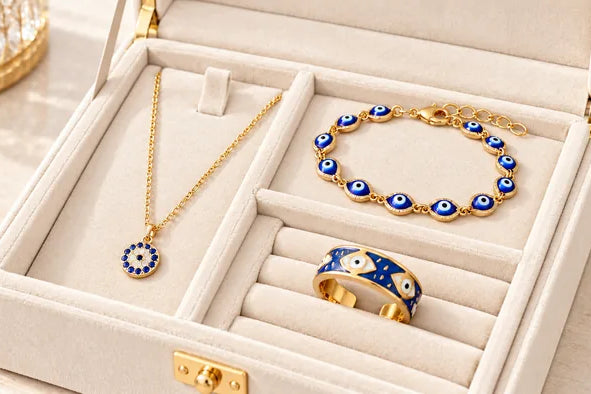
178
Products
Evil Eye Jewelry
Shop Evil Eye jewelry in symbolic necklaces, bracelets, rings, earrings, pendants and charm styles for everyday layer...
Explore
39
Products
Evil Eye Fashion
Explore evil eye fashion across graphic T-shirts, hoodies, sweatshirts, beach shirts, iPhone cases, AirPods cases, ph...
ExploreClosing on hamsa vs evil eye
Put plainly, the Hamsa is a protective hand and the evil eye is a watchful gaze, two shapes for the same wish.
From there, let your taste and the person you're shopping for decide. A detailed hand holds up on its own. So does a quiet blue eye, or the two layered together. Wear the one whose meaning sits right with you.
