

Back to Evil Eye
The blue evil eye meaning comes from the Nazar’s traditional association with protection from a harmful gaze. The evil eye is the gaze believed to cause harm; the Nazar is the eye-shaped amulet traditionally associated with protection against it.
Dark and light blue designs share that symbolism. Focus or resolve for dark blue, and calm or clarity for light blue, are modern readings—not an inherited color code or a promise of protection.
Dark and light blue share the Nazar’s traditional protective association. Their differences lie in visual mood and personal interpretation, not in stronger protection.
What does a blue evil eye mean?
In cultural tradition and folklore, the blue Nazar is understood as a protective symbol. It may connect someone with a family practice or, as a gift, quietly say, “I care about you.”
That meaning is symbolic, not a scientifically verified effect. Nazar jewelry or decor cannot guarantee protection, and people may also appreciate the motif for its color and graphic shape.

The evil eye belief and the Nazar amulet
Britannica describes the evil eye belief as the idea that a glance can cause harm. The University of Kansas CREES overview describes the Nazar as an eye-shaped amulet associated with protection against that gaze.
The amulet is not the harmful gaze itself. Nazar traditions appear across regions and communities, so assigning the symbol to one country or religion leaves out important context.
What does a blue Nazar mean in everyday use?
In daily life, the blue Nazar meaning combines protective folklore with family or cultural ties. On a bracelet or necklace, the motif may remind the wearer of the care behind it.
A classic Nazar is a recognizable evil eye symbol, usually formed by white and light-blue rings between a dark-blue outer field and a black pupil. The pattern is recognizable, but each ring does not have a universally fixed meaning.
Modern listings often connect blue with steadiness or calm, and some also mention clarity. These ideas may guide a choice, but historical sources do not establish one shade of blue as more protective than another.
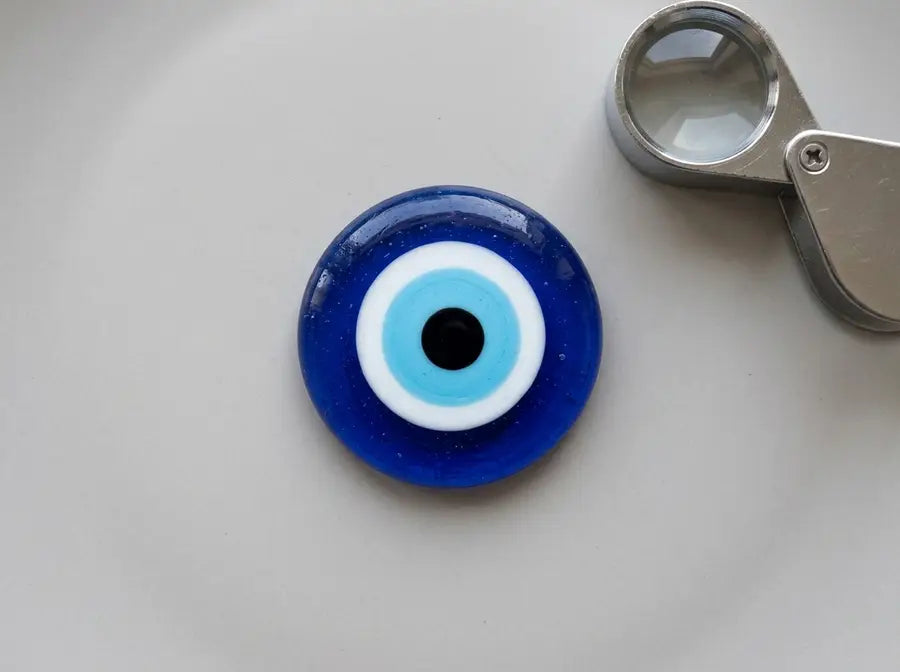
Why is the Nazar commonly blue?
There is no single proven answer. “Why is the evil eye blue?” usually uses evil eye as shorthand for the Nazar amulet rather than the harmful gaze.
Some explanations draw on regional folklore about blue eyes. Others point to blue’s association with the sky or water. Blue-and-white eye patterns also appear in ancient glasswork, but no theory has been established as the sole origin.

Folklore surrounding blue eyes
In some regional stories, blue eyes became associated with the harmful gaze, especially where the color looked unusual. This may account for part of the Nazar’s color history.
The belief was not shared by every community and cannot fully explain the familiar blue design. It provides context, not a complete answer.
Broader symbolism of blue
In contemporary color language, blue often evokes sky and water. It is also linked with calm or steadiness. These associations can shape present-day readings of the Nazar, but they vary across contexts and do not establish why historical makers chose blue.
Glassmaking and material history
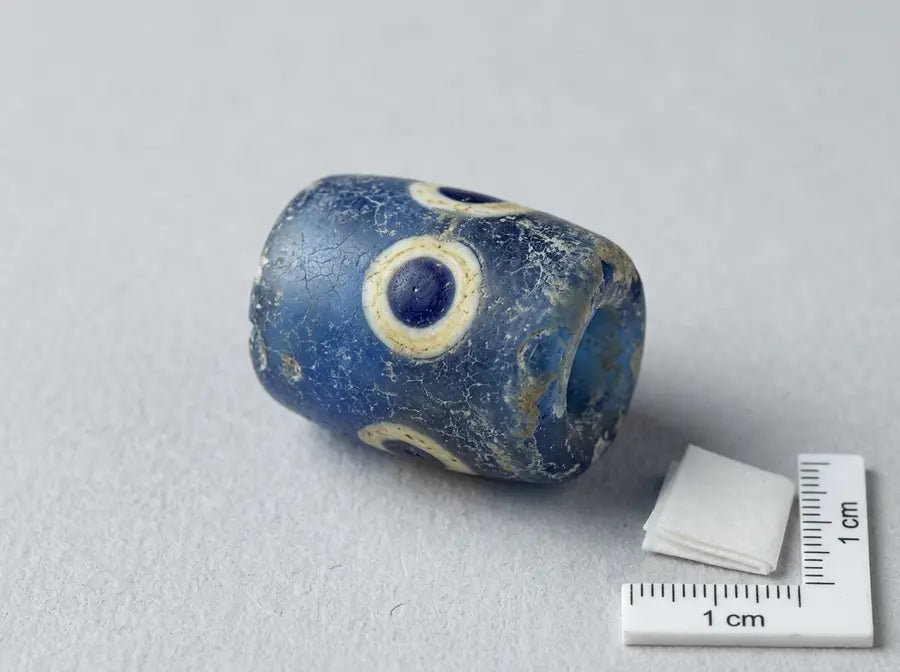
The Metropolitan Museum of Art records a Greek glass eye bead from the Eastern Mediterranean, dated to around the fourth century BCE. Blue-and-white eye patterns sit against its blue body.
The bead confirms that blue glass and eye imagery appeared together in antiquity. It does not prove the object’s function, an unbroken line to the modern Nazar, or why later designs became blue.
Why no single origin should be claimed
Ancient eye imagery provides context, but visual resemblance is not proof of identical meaning. An old eye-shaped object is not automatically an evil-eye charm.
The Met describes the Tell Brak eye idol as a probable offering whose wide eyes expressed attentiveness to the gods. It does not identify the object as an evil-eye amulet.
Dark blue vs. light blue evil eye meanings
Dark blue and light blue Nazars share the same protective association in tradition and folklore. No widely documented traditional rule assigns different protective strength to dark blue and light blue.
Focus and resolve for dark blue, or calm and clarity for light blue, come from contemporary color language. These readings can guide a choice, but they are not inherited facts.
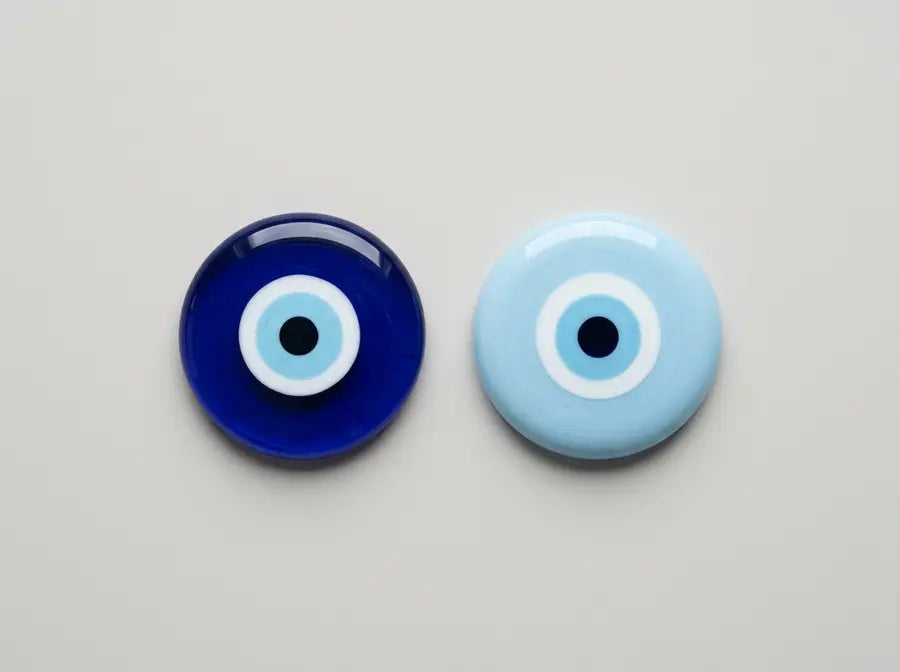
Dark blue evil eye meaning
The dark blue evil eye meaning is often framed around steadiness or focused resolve. Someone facing a demanding period might choose it as a reminder to stay grounded, without claiming the bead can change events.
Dark blue has visual weight. It stands out against black cord or yellow gold; white beads make the contrast even sharper. The shade also suits a chunkier bracelet or larger pendant.
Light blue evil eye meaning
Modern interpretations connect the light blue evil eye meaning with calm or clarity; some also read it as openness. Pale blue pairs easily with silver or white beads and also works with faded denim or softer clothing colors.
On a small charm, light blue makes the eye motif quieter at the wrist or neckline. That changes the look, not the symbol’s level of protection.
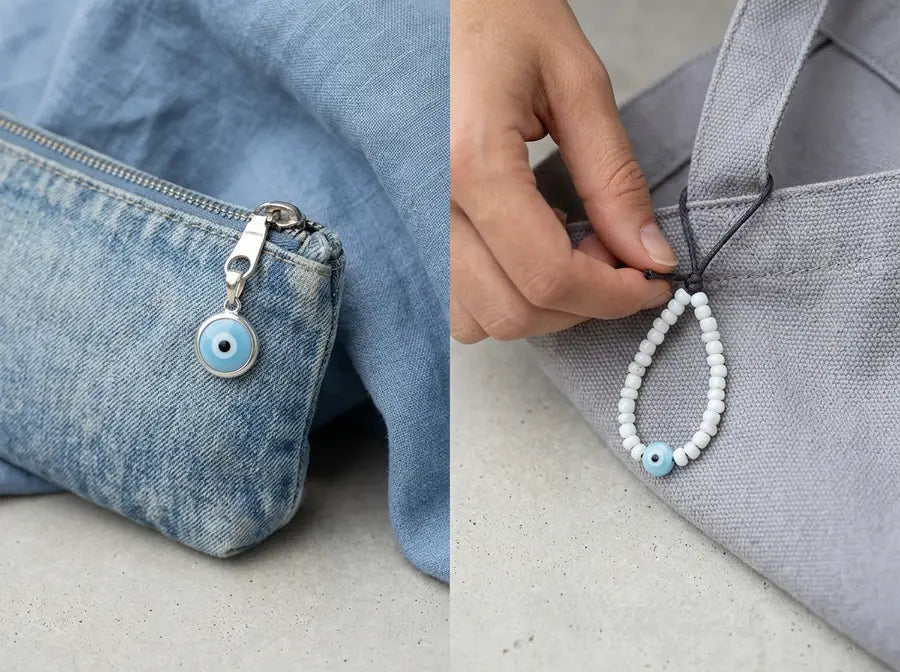
Shared meaning and personal preference
With no documented shade hierarchy, personal association and appearance are useful selection points. If you are deciding how to pick an evil eye piece, compare options of similar size and material so color, rather than scale, drives the decision.
- Dark blue: retains the Nazar’s protective symbolism and tends to look more graphic. Modern readings may connect it with steadiness or resolve.
- Light blue: carries the same core meaning but often looks quieter in delicate jewelry and airy rooms. Calm and clarity remain contemporary associations rather than fixed traditional meanings.
Blue vs. turquoise evil eye pieces
Turquoise is not labeled consistently in jewelry and decor listings. A bead called turquoise in one shop might be labeled aqua or sky blue elsewhere, while another seller may simply call it light blue.
Lighting and screen settings can shift the color, and the material may change how it appears too. A product label cannot establish a precise shade or give it a separate traditional meaning.

Is turquoise a separate meaning?
No universal traditional boundary sets turquoise apart as a Nazar category. Most shade-specific claims come from contemporary color interpretations rather than an inherited code.
A wearer may attach a personal meaning to turquoise, but that association does not represent a fixed traditional code.
How to compare shade labels
Look first at photos taken in neutral, consistent light, then check the material. Glass often shows depth and reflections, while enamel or printed surfaces appear flatter.
Choose the shade that works with the intended wardrobe or room. Treat claims that darker colors are more powerful with skepticism because Nazar symbolism does not assign them greater protective strength.
Blue evil eye bracelet and jewelry meaning
Jewelry keeps the Nazar visible and easy to wear. Visibility matters when choosing an evil eye bracelet for everyday use: it stays in sight, while a necklace or small earrings can make the motif more discreet.
The Nazar also works naturally in layered charm jewelry. Its cultural history extends beyond the trend, so accurate language matters more than claims about what it can do.

What can a blue evil eye bracelet symbolize?
The blue evil eye bracelet meaning follows the Nazar’s broader protective symbolism rather than its format. It may connect with family practice or express a giver’s care.
For a simple stack, pair one Nazar bracelet with a slim chain or plain cord and leave the eye visible. Dark blue contrasts with gold or black; light blue blends with silver and pale beads.
Scale matters for gifts. A small station charm suits restrained jewelry, while a full glass-bead strand suits someone who likes bold accessories.
The bracelet remains symbolic, with meaning grounded in cultural context and personal intention.

Delicate Turkish Evil Eye Charm Bracelet - An Adjustable, Radiant Gold Colored, Copper Chain Accessory for Modern Women
$10.93 - $11.06
View
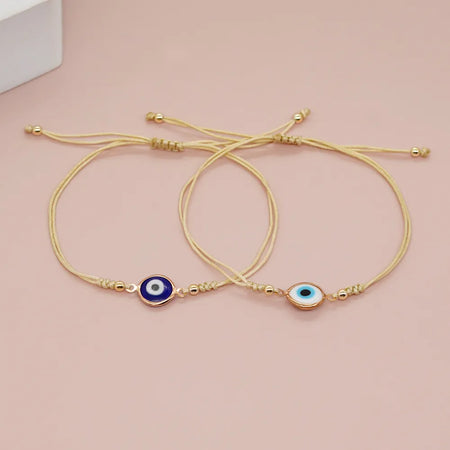
Eye-Catching Adjustable Enamel Evil Eye Friendship Bracelet – Unisex, Vibrant Summer Accessory
$9.85
View
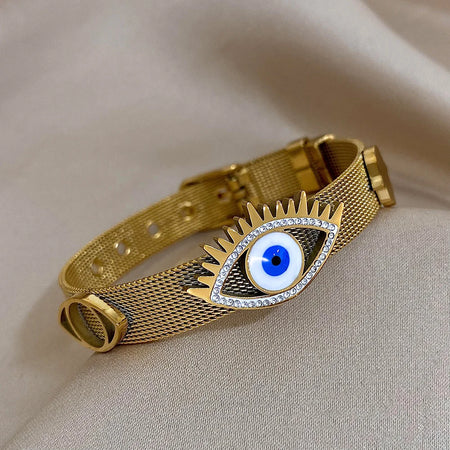
Elegant Stainless Steel Evil Eye Bracelet for Women - Gold Chain & Link Fashion Jewelry
$12.15
View
Necklaces, earrings, and other jewelry
Choose the format by comfort and desired visibility. A medium pendant works over a crew-neck top or at an open collar; studs and fine charm necklaces keep the motif understated.
Give a Nazar pendant space when layering. Place it above a longer plain chain instead of crowding detailed charms at the same length.
Scale and placement change the styling, not the core symbolism. No jewelry format is more effective than another.

58
Products
Evil Eye Bracelets
Shop Evil Eye bracelets for everyday style, layered wrist looks, and meaningful gifts. Explore beaded, charm, cuff, b...
Explore
179
Products
Evil Eye Jewelry
Shop Evil Eye jewelry in symbolic necklaces, bracelets, rings, earrings, pendants and charm styles for everyday layer...
ExploreDoes the wrist or direction change the meaning?
There is no universal rule for wearing a Nazar on the left or right wrist. There is also no broadly shared requirement for which way the eye must face.
If a family or community follows a custom, use that as the reference. Otherwise, wear the bracelet on the comfortable side.
Using blue Nazar pieces in gifts, DIY, and home decor
A blue Nazar draws meaning from where it is used and who chose it. In a gift or home, it might reflect cultural ties or thoughtful intention. Some people may simply appreciate the design.
These uses remain symbolic or decorative, even when they draw on protective folklore. The setting can make the gesture personal without turning it into a supernatural claim.
Giving a blue Nazar respectfully
Before choosing an evil eye gift, consider how the recipient views the motif and whether it has cultural or religious meaning for them. For a graduation or move, a bracelet or keychain can carry a warm message.
A note might call it “a traditional symbol of protection and care” and explain the shade choice. Skip promises about safety or healing, and avoid claims about luck or changed energy.
Choose a fine light blue charm for someone who wears delicate jewelry. A larger dark blue bead or wall hanging suits someone who prefers a more graphic look.

Using blue Nazar beads in DIY projects
For a handmade accessory, match the bead diameter and hole size to the cord or findings. A heavy bead can overwhelm a fine chain, while a narrow bead hole may not accommodate thick elastic.
Once the construction makes sense, choose the shade for the palette and personal meaning. Plain spacers give an eye bead room in a busy strand.

10
Products
Evil Eye Beads
Shop evil eye beads for jewelry making, from statement beads to subtle spacer styles for bracelets, necklaces, earrin...
Explore
50
Products
Evil Eye Home Decor
Shop Evil Eye home decor, from wall hangings and decorative accents to stylish pieces for shelves, tables, and everyd...
ExploreDisplaying a blue Nazar at home
An entryway or living room can keep a Nazar visible as a cultural symbol or decoration. A small piece works near a key tray; a larger hanging needs enough open wall for the eye shape to read clearly.
In a shared area, check that others are comfortable with the symbol and describe it simply as a cultural symbol or decoration.

Placement and everyday accessories
There is no single correct placement. When incorporating evil eye home decor such as wall hangings and desk objects, consider the sightline and secure mounting first. Nearby colors affect how clearly the eye motif reads.
Bag charms and keychains receive more handling, so size and attachment style need extra thought. Choose a setting that respects the shared space and suits the owner.

Artfully Crafted, Adjustable Turkish Evil Eye Charm Bracelet – Perfect Accessory for a Fashion-forward, Summer Boho Look
$11.96 - $12.04
View
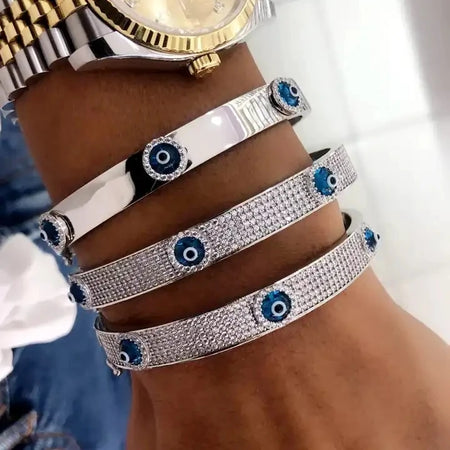
Luxurious Platinum-Plated Evil Eye CZ Bangle Bracelet with Sparkling Micro Pave Design for Women
$16.76 - $18.59
View

Chic and Versatile, Adjustable Turkish Evil Eye Charm Bracelet – An Essential Bohemian Summer Accessory for Style-conscious Individuals
$11.19
View
How to choose a blue Nazar piece respectfully
Start with where the Nazar will be worn or displayed and which shade the owner likes. Then consider the recipient’s connection to the symbol and the practical demands of the format.
- Choose by preference. Compare pieces made from similar materials, and ignore claims that one shade offers greater protection.
- Check fit and durability. Jewelry should suit the wearer’s usual scale and comfort. Loose beads need the right hole size, while keychains or decor should handle their expected wear.
- Read the description closely. Prefer sellers who ground the Nazar in its cultural or folkloric context and avoid promises of specific results.
- Consider the recipient. Think about their taste and known family or community traditions. If eye imagery may feel sensitive or unwelcome, ask before choosing it.
Blue Nazar FAQ
Nazar practices vary across regions and communities, including from one family to another. Local context is more dependable than broad rules about who may wear one, which wrist to wear it on, or what a certain blue can do.
Is the Nazar Turkish or Islamic only?
No. The Nazar is strongly associated with Türkiye, but related amulet traditions appear in multiple regions and in religious and secular settings.
Turkish usage is prominent without defining the symbol’s full cultural range. Practice can shift with local and family context.
Is a Nazar the same as a Hamsa or another eye symbol?
No. A Hamsa vs Evil Eye comparison begins with form: a Nazar is an eye-shaped amulet, while the Hamsa is primarily hand-shaped, though it sometimes contains an eye.
The Eye of Horus and Eye of Providence have their own forms and histories. Contemporary objects may combine them, but a shared eye shape does not make their meanings interchangeable.
Does dark blue offer stronger protection than light blue?
No widely documented traditional rule gives dark blue greater protective power. Both shades carry the Nazar’s broad protective symbolism.
Strength or focus for dark blue, and calm or clarity for light blue, are contemporary associations. They are not verified powers or an ancient scale of effectiveness.
Can anyone wear or give a blue Nazar?
No single rule governs every community. When giving or wearing a Nazar, consider the person’s comfort and family or religious context. If the meaning may be sensitive, ask rather than assume.
Choosing blue with context
The Nazar’s protective tradition remains the shared base of the blue evil eye meaning. Dark blue resolve and light blue calm can be useful personal readings, but neither shade carries greater symbolic strength.
A pale bracelet and a dark blue pendant can share that meaning with a turquoise wall hanging, even though each looks different in use. Choose the piece that suits the person or room, and describe it accurately.
